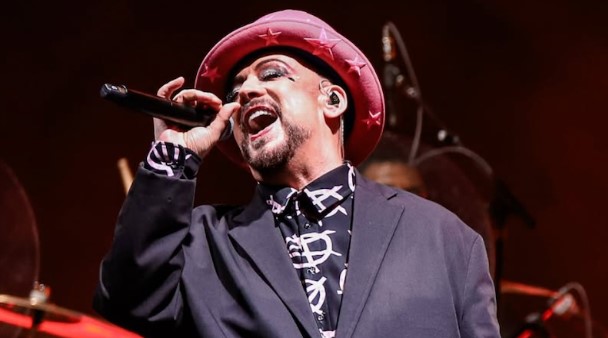
The 70th edition of the Eurovision Song Contest is already shaping up to be one of the most unpredictable and star-studded in its storied history. As the world prepares to gather at the iconic Wiener Stadthalle in Vienna, Austria this May, a bombshell announcement has rattled the music industry and ignited the global LGBTQ+ community. Boy George, the gender-bending pioneer and Culture Club legend, has officially entered the race. However, in a twist that only the complex cultural landscape of 2026 could provide, he isn’t flying the Union Jack for the United Kingdom. Instead, the icon is set to compete in San Marino’s national selection alongside Italian Eurovision veteran Senhit. The Boy George Eurovision 2026 campaign is centered around a high-octane track aptly titled “Superstar,” and it promises to bring a level of star power that the “microstate” of San Marino has never seen before.
The San Marino Coup: Why Boy George Chose the “Smallest” Stage
The decision for an artist of Boy George’s magnitude to represent San Marino may seem baffling at first, but in 2026, it represents a masterful strategic move. San Marino has increasingly become a playground for established global stars looking for creative freedom and a “guaranteed” path to the main stage, having previously hosted icons like Flo Rida. By teaming up with Senhit—who famously represented the country in 2011, 2020, and 2021—Boy George is tapping into a pre-existing “Eurovision family” that values spectacle and camp over traditional borders.
The Boy George Eurovision 2026 bid is not just about a song; it’s about a legacy artist reclaiming his place in the digital age’s most significant televised musical event. This “owning of the narrative” is something we see across the celebrity spectrum this year, most notably in Lisa Rinna’s 2026 memoir, where she similarly takes control of long-standing public rumors. Just as Rinna refuses to be silenced by gossip, Boy George is refusing to be relegated to the “nostalgia” circuit, choosing instead to compete on the world’s most vibrant stage.
A Contrast in Strategies: The UK vs. The Icon
While Boy George seeks glory through San Marino, the United Kingdom has taken a radically different path for 2026. The BBC recently announced that YouTube star and synth-pioneer Look Mum No Computer (Sam Battle) will represent the UK in Vienna. This shift toward “DIY” and experimental music is a bold move, but it has left some fans wondering if the UK missed an opportunity to send its own legends.
This tension between institutional choices and individual expression is a recurring theme in 2026. We see it in the sports world, where Real Madrid’s Thibaut Courtois has taken a stand against gay slurs, demanding that the establishment modernize its disciplinary codes. Much like Courtois is challenging the status quo on the pitch, Boy George’s move to represent San Marino is a challenge to the traditional “gatekeeping” of national broadcasters. In Vienna, we may well see a showdown between the UK’s experimental future and San Marino’s legendary past.
The Flag of Freedom: From Vienna to Stonewall
Eurovision has always been a celebration of flags and national identities, but in 2026, those symbols carry more weight than ever. As Boy George prepares to wave the flag of San Marino, the LGBTQ+ community is celebrating another historic victory for our own symbols. The introduction of the Stonewall National Monument Pride Flag Protection Act 2026 ensures that the rainbow flag remains a permanent feature of our most sacred monument.
Whether it is the San Marinese flag on a Eurovision stage or the Pride flag in Christopher Park, these symbols represent a refusal to be erased. Boy George’s “Superstar” campaign is part of this broader movement of visible, unapologetic queer presence. In a year where federal threats are constant, the ability to fly our flags—both national and communal—is an act of profound resistance.
Digital Fandom and the Right to Privacy
The Boy George Eurovision 2026 announcement has already generated millions of interactions across digital platforms. However, the excitement of global fandom also brings the risk of increased surveillance and data harvesting. This is why the recent Discord age verification delay 2026 victory is so crucial for Eurovision fans.
Without the threat of mandatory ID linking, fans can celebrate, theorize, and organize their watch parties on Discord with a sense of security and anonymity. This digital privacy allows the “Superstar” hype to grow organically, proving that safe digital sanctuaries are the bedrock of modern queer culture. Boy George’s fans, who span generations from Gen X to Gen Alpha, deserve to engage with their idol without compromising their digital safety.
The Paradox of Choice: Eurovision vs. MAGA Politics
The inclusive, borderless energy of Eurovision stands in stark contrast to some of the exclusionary politics we’ve seen emerging within our own community. As Boy George invites everyone to join his “Superstar” journey, we are reminded of the recent Gay MAGA fan dating crisis 2026, where political contradictions have led to social ostracization.
While Eurovision seeks to unite Europe through music and diversity, the MAGA movement often targets the very rights that allow queer artists to thrive. The “Superstar” bid is a celebration of the “Euro-vision” of a united, diverse continent—a vision that many in the community are choosing to defend by “swiping left” on those who align themselves with hostile political ideologies.
Heated Rivalries and Musical Passion
As the countdown to May begins, the drama of the Eurovision stage is finding a parallel in the world of scripted entertainment. The confirmation of the Heated Rivalry Season 2 release date 2026 has fans of Shane and Ilya eagerly anticipating their return to the ice.
There is a natural synergy between the high-stakes passion of a hockey rivalry and the “all or nothing” glamor of a Eurovision performance. Just as fans have found a “safe haven” in the Heated Rivalry cottage, they find a similar sanctuary in the 3-minute brilliance of a Boy George performance. Both offer an escape into a world where queer joy is the primary narrative, and where the “long game” always leads to a standing ovation.
The Road to Vienna: May 12, 14, and 16
As we look toward the grand final on May 16, 2026, the question remains: Can Boy George actually win? The contest, held at the Wiener Stadthalle—where the Green Room will be transformed into a classic Viennese coffee house—is known for its “zero-gravity” unpredictability. George’s song “Superstar” is described as a high-octane dance track with a retro-futuristic soul, produced by a team that includes Swedish Eurovision maestros and San Marinese innovators.
If he succeeds, he will follow in the footsteps of previous icons who used the stage to send a message of global unity. Whether he takes home the trophy or not, the Boy George Eurovision 2026 bid has already succeeded in making the contest more colorful, more legendary, and more queer than ever before.
Conclusion: An Unstoppable Superstar
Boy George’s journey to San Marino is a testament to the fact that icons don’t fade away; they simply find a new spotlight. In a world of shifting politics, digital privacy battles, and ice-cold hockey rivalries, the “Superstar” of the 80s remains as relevant as ever. At gay-chat.org, we will be following every step of the journey to Vienna. The message for 2026 is clear: the borders are open, the music is playing, and everyone—from the football pitch to the Eurovision stage—is invited to the party.
⚖️ Stay Connected with Gay-Chat.org:
- Lisa Rinna’s 2026 Memoir: Owning the narrative in 2026.
- Courtois and the Fight for Equality: Taking on homophobia in sports.
- Stonewall Flag Victory: Protecting our symbols in a federal age.
- Heated Rivalry Season 2: The return of Shane and Ilya.